Past Projects 2010-2011
Students selected the following list of projects to develop for academic year 2010-2011. These projects were selected from a list of prospective projects and have an advisor in the Computer Science Department supervising their technical aspects.
Team DistroWhale [External Link] took top honors in the Department of Computer Science’s Ninth Annual Outstanding Senior Project Competition, May 24, 2011. Team AHOY received second place, with Teams GPUnit and Stlyo/Anonymouth garnering honorable mentions.
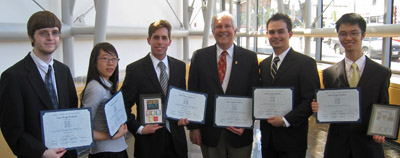
(L-R) Kevin Smiley, Anna Luong, Frank Weindel, Jeff Popyack (advisor), Klevis Xhelilaj and Kevin Cheung. (External stakeholder: Zenkaikon, Drexel Admissions and College of Engineering)
DistroWhale [External Link] team members, Kevin Cheung, Anna Luong, Kevin Smiley, Frank Weindel, and Klevis Xhelilaj, created a system for distributing schedules via smartphone to people attending events with multiple sessions, such as conventions or conferences. DistroWhale includes an administrative website for conventions to input their event schedule, exhibitor information, maps, and alerts into a database. Attendees have access to features, such as interactive maps, a personal schedule, and real-time updates and alerts from the convention, on their mobile device.
Team DistroWhale competed in the College of Engineering’s Senior Design Competition Thursday, June 2, 2011, joining seven groups representing their respective departments, and received an honorable mention.
AHOY (L-R): Frank Clark, Maria Kolakowska, Aaron Rosenfeld and Dustin Ingram; advisor Bill Regli. (External Stakeholder: Joe Macker, US Naval Research Laboratory)
AHOY [External Link] is an event-based simulation environment designed to test networked multi-agent systems. Through user-defined, interchangeable component models, the effectiveness of different combinations of software agents, network configurations, and sensors can be tested in real-world environments.
GPUnit (L-R): Jeremy Johnson (advisor), Andrew Sherman, Gabe Schwartz, Tim McJilton, Jason Economou, Rajkumar Jayachandran, and Daniel Bagnell.
GPUnit [External Link] worked with the Astrophysical Multipurpose Software Environment (AMUSE) project, which developed a software framework for large-scale simulations of dense stellar systems. The team worked on a framework level of AMUSE and created a set of features for easing the process of parallelization among multiple GPU’s and within a single GPU. The tool followed AMUSE’s goal of easing the process of creating scientific tools in order to run experiments more effectively..
Stylo: Kyle Musal, Aaron Chapin, Andrew Orner, and Matthew Tornetta; Anonymouth: Armon Entezari, Karan Hansaria, Jon McGrath, Chris McGuire, and Paul Vu; advisor Rachel Greenstadt.
The Anonymouth tool is part of a larger tool called Stylo, which anonymizes the writing submitted by authors. The anonymization of the writing is composed of two functions: analyzing its structure and suggest improvements for it. Anonymouth’s tool does the latter of the two functions. Data from the analysis process is interpreted after its completion and Anonymouth recommends changes in the writing sample. The stylometry portion of Stylo [External Link] provides an interface for an author to submit his work for analysis. During analysis, Stylo collects statistics on certain features that can be used to identify an author.
# |
Name and Team |
Description |
Outside Stakeholder |
Supervising Faculty |
| 1 |  S.E.W.D: Simple Elegant Web Design John Martino Mike Witucki Gurvinder Singh Dan Weaver Ashwin Hamal Final Presentation |
SEWD will be an application that provides even the most novice of users with the tools necessary to create a robust, fully functional website. With little to no knowledge of web programming, design, or coding experience, SEWD will empower end users to generate detailed, intricate web pages to their specification. The intuitive GUI of SEWD gives users the option to easily choose from a number of prefabricated site templates including e-commerce, blog, photo gallery, intranets, etc. Users are able to modify color schemes and page layouts as they see fit. SEWD seamlessly integrates content from a common database such that material can be stored and modified at the user’s digression, without ever exposing the nuts and bolts of database usage. SEWD also includes a number of ‘widgets’, or customizable objects that can be placed on pages to further personalize the capabilities of the websites produced. | N/A | Jeff Salvage |
| 2 |  Ahoy Dustin Ingram Maria Kolakowska Frank Clark Aaron Rosenfeld Final Presentation (Final Four) |
AHOY is an event-based simulation environment designed to test networked multi-agent systems. Through user-defined, interchangeable component models, the effectiveness of different combinations of software agents, network configurations, and sensors can be tested in real-world environments. Scenario definitions specify a high-level model of a simulation's attributes, allowing for nondeterministic experiment progression. Real-time execution enables the integration of human interaction with the simulation. The distributed simulation engine provides the ability to run large-scale, complex experiments, reducing the cost of otherwise economically infeasible experiments. | Joe Macker, US Naval Research Laboratory | Dr. Bill Regli |
| 3 |  Anonymouth Armon Entezari Karan Hansaria Jon McGrath Chris McGuire Paul Vu Final Presentation (Final Four) |
The Anonymouth tool is part of a larger tool called Stylo, which anonymizes the writing submitted by authors. The anonymization of the writing is composed of two functions; analyzing its structure and suggest improvements for it. Anonymouth's tool does the latter of the two functions. Data from the analysis process is interpreted after its completion. The spelling of words, the number of words per sentence, how many words are used on average in a sentence, punctuation usage, and the number of distinct words in a writing sample are some examples of how the data is interpreted. Anonymouth then recommends changes in the writing sample. These include using synonyms for certain words, changing the punctuation in sentences, and rewording sentences to mimic the writing style of another author. User interaction will be with a GUI with a controller that combines the functionality of Stylo and Anonymouth. |
N/A | Rachel Greenstadt |
| 4 |  Distro Kevin Cheung Anna Luong Kevin Smiley Frank Weindel - Lead Klevis Xhelilaj Final Presentation (Final Four) |
DistroWhale is a system for distributing schedules to mobile devices for events like conventions. The target market would be conventions with many simultaneous events going on throughout the day. DistroWhale would include an administrative website for conventions to input their event schedule, exhibitor info and maps into a database. A server will distribute this information to mobile device applications made for various platforms such as iPhone and Palm. The mobile applications would provide features to enhance a convention attendee’s experience. Some of the features include interactive maps, to-do lists and the ability to share these lists with friends. It could also include coupons and advertisements for exhibitors, and nearby restaurants. Conventions could also better communicate special announcements, such as schedule changes and public safety information, through the system as well. | ColossalCon | Jeffrey Popyack |
| 5 |  ANFS Lee Trager Harry Anuszewski Michael Dalton Arkadiy Sherman Matt Wyatt Final Presentation |
The goal of ANFS (Advanced Network File System) is to add new features to the NFS (Network File System) protocol (RFC 5661). These features will be implemented in the existing GNU/Linux implementation of NFS which will enable development to focus on new features only. Encryption of data sent to and from a NFS server is a critical feature missing in the current NFS protocol. Without native encryption support to NFS alternative methods must be used which take additional resources or it can not be deployed in a hostile environment such as the Internet. Compression between server and client is another useful feature that will help NFS be deployed over high latency networks. We plan to research proper algorithms for both encryption and compression and add them to the protocol. Another major feature of ANFS is support for redundant servers. This will enable NFS to have multiple servers so in case of a server failure the client will never notice. | N/A | Yuanfang Cai |
| 6 |  The Drexel Ride Mark Korsak Rashid Al-Naemi Mike Vadovszki Final Presentation |
This project will be working on a 6 Degrees of Freedom motion platform donated by ETC inc. and will be supervised by Professor Paul Diefenbach. Entertainment venues hosting motion platforms face the problem that the platforms generally cost millions of dollars to acquire and can only seat 2 people at a time. For that reason, they are seen as very cost inefficient as a single ride for two people is too long for it to be profitable. We set out to create a game that will use laptops and various devices running Android and/or iOS to allow people not in the vehicle to take part in the game in order to maximize participation. This will allow the motion platform’s hosts to increase turnover rate in the same amount of time it usually takes for a single ride with only two people. |
Paul J. Diefenbach | |
| 7 |  Siberia CMS Nikita Byalsky Bjorn Carandang Steve Cornella Alex Ivanov Ryan Ross Final Presentation |
Siberia CMS is an asp.net c# content management system with a focus on making it easier for a technically-knowledgeable developer to implement solutions to business objectives. Siberia's focus is on ease of use, extensibility, customization, and flexibility. The content management system will give the developer an easy way to define data types, roles, permissions, and other business logic, either through an admin interface or via a config file. It will thus offer a high level of customization without requiring the developer to write custom code. Also, the cms will decouple content from the display method, offer support for easy but custom theming, and modular functions such as content display options, themes, and any feature plugins such as ecommerce will be standardized in order to allow new modules to be developed easily. | N/A | Jeff Salvage |
| 8 |  Curious Jonathan Ryan Stacey Wrazien Mayra Aguas Henry Blum Jasmine Phillips Final Presentation |
Curious is a desktop environment that revolutionizes how users visualize, organize, manipulate, and store their data. Instead of using applications, users directly interact with visual representations of their data. They are allowed to freely organize their data into groups related to their current activity. This allows users to perform certain actions on the data based on the data's relationships. The interface for the desktop environment is in the form of a three-dimensional, zooming user interface. Details about the data are revealed as users zoom closer to it. Specific actions that can be performed involving the data are also exposed based on the zooming actions. It runs on Windows, Linux, Mac and is portable to mobile devices. |
N/A | Dario Salvucci |
| 9 |  Stylo Kyle Musal (Team Lead) Aaron Chapin Andrew Orner Matthew Tornetta Final Presentation (Final Four) |
The stylometry portion of Stylo will provide an interface for an author to submit his work for analysis. During analysis Stylo will collect statistics on certain features that can be used to identify an author. Features include but are not limited to: word count, word length, sentence complexity, white-space usage and punctuation usage. After analysis Stylo will display its results to the user. Results will include the name of the author Stylo thinks the work belongs to, a percentage on how sure it is, and the features used make this determination. The Stylo stylometry tool will also be capable of exporting its results to the Stylo anti-stylometry tool. | N/A | Rachel Greenstadt |
| 10 |  GPU Unit Gabe Schwartz Andrew Sherman Rajkumar Ramachandran Daniel Bagnell Jason Economou Tim McJilton Final Presentation (Final Four) |
We will be working with the Astrophysical Multipurpose Software Environment(AMUSE) project. AMUSE’s aim is to provide a software framework for large-scale simulations of dense stellar systems, in which existing codes for dynamics, stellar evolution, and hydrodynamics can be easily coupled, and place them in the appropriate observational context. A software engineering team in the Netherlands has been heading up this project for some time. Our group will be working on a framework level of AMUSE, creating a set of features for easing the process of parallelization among multiple GPU’s and within a single GPU. This tool will follow AMUSE’s goal of easing the process of creating scientific tools in order to run experiments more effectively. |
Prof. Steve McMillan Alfred Whitehead |
Jeremy Johnson |