Past Projects 2006-2007
Students selected the following list of projects to develop for academic year 2006-2007. These projects were selected from a list of prospective projects and have an advisor in the Computer Science Department supervising their technical aspects.
This year there were 18 projects. Of the 18 projects, five were selected to compete in the third annual Outstanding Senior Project Competition. The competition was held in Disque 103 and was open to all students, faculty and guests.
Students competed for cash prizes and recognition on the department senior project plaque. This year's awards were made possible through donations from Lockheed Martin, Microsoft, Siemens, SMART and Associates, Susquehanna International Group (SIG), and Unisys. SeeSeniorDesign2007.pdf for the flyer announcing this event.
As always, our students and advisors did a great job. There were many outstanding projects and the department had a difficult task in selecting those to advance to the next stage. This year there were five teams in the final competition. They were ranked as follows:
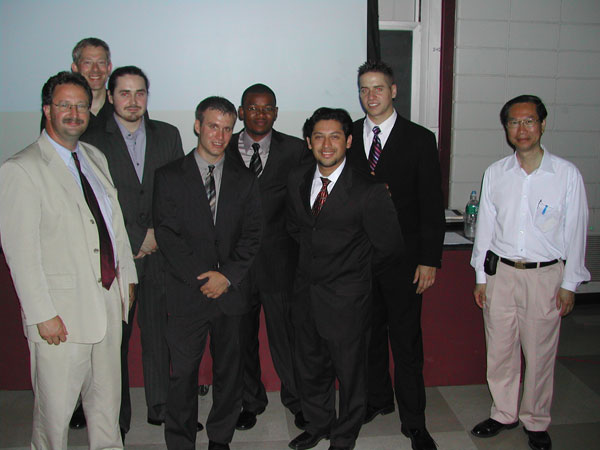
1st Place ($1,000)
Team 15: RCCM - Remote-Controlled Crack Monitoring
Team Members: Brian Fellon (MEM, Administrative Lead), Michael Bartholomew, Mark Davis, Danny Garcia (MEM), Bachir Abba (MEM)
Advisor: Werner Krandick (CS), Jonathan Awerbuch, Alan Lau, Tein-Min Tan (MEM) and John Bakuckas (FAA)
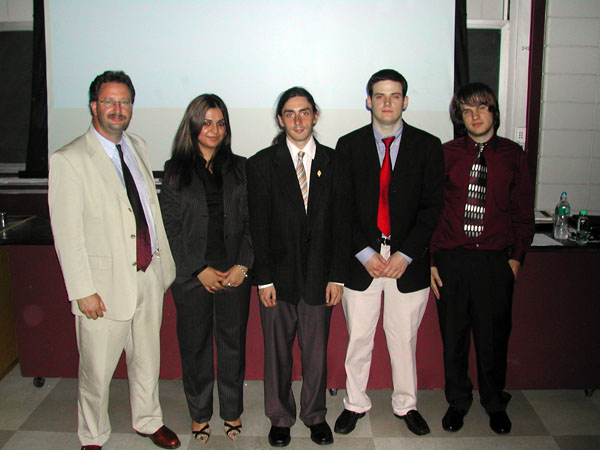
2nd Place ($500)
Team 7: MSDTool

Team Members: Joshua Shaffer (Team Lead), David Turner, Mark Zuber, Sonal Gupta
Advisor: Dario Salvucci (CS), Surya Kalidindi and David Fullwood Dept. of Materials Science and Engr.
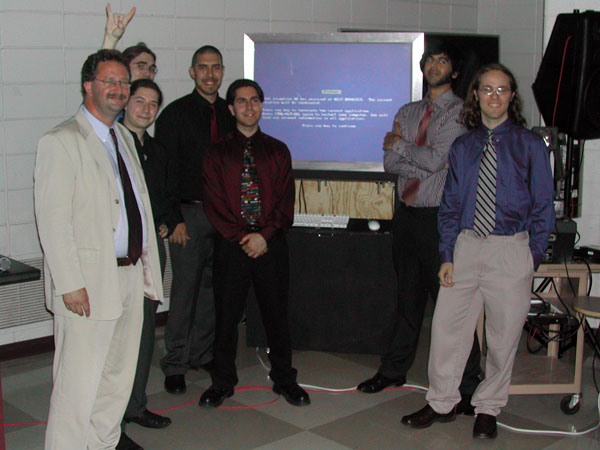
3rd Place ($300)
Team 2: InfiniTouch - A multi-point touch screen for making music
Team Members: William Morgan (Team Lead), Boris Block, David Millar, Dan Hennessey, Vijay Balchandani, Zenko Klapko
Advisor: Frank Lee (CS), Tim Kurzweg (ECE), Youngmoo Kim (ECE), Steve Funk, Scott Charles Music Industry Seniors College of Media Arts & Design
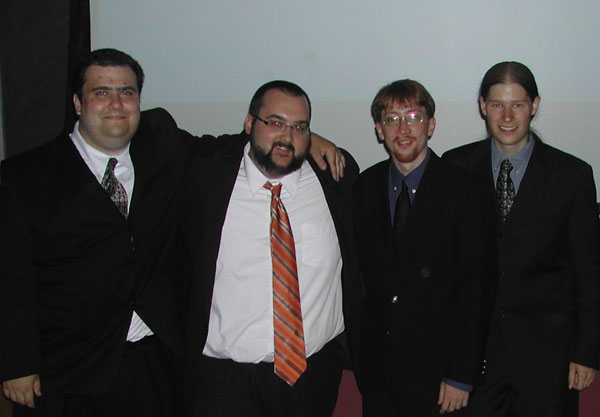
4th Place ($250)
Team 8: Skills Inventory Tracking System (SITS)
Team Members: David Oakes (Team Lead), Lawrence Katz (Technical Lead), Jeff Hamel, Darshil Amin, Joseph Pace
Advisor: Werner Krandick (CS),Fran Cornelius and Mary Gallagher-Gordon (Nursing)
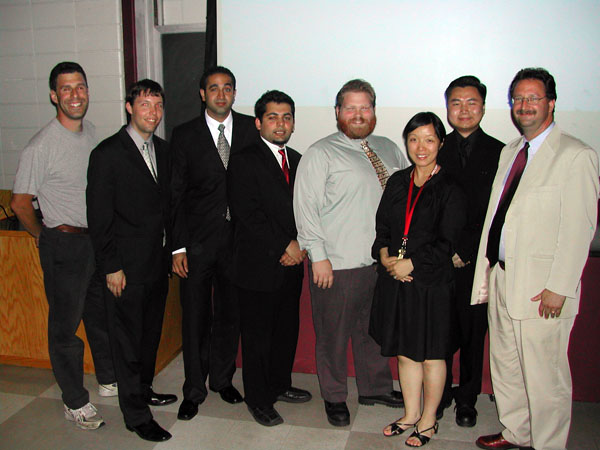
5th Place ($250)
Team 6: Vodka: Organizational Device for Keeping Assets
Team Members: Brian Fellon (MEM, Administrative Lead), Michael Bartholomew, Mark Davis, Danny Garcia (MEM), Bachir Abba (MEM)
Advisor: Werner Krandick (CS), Jonathan Awerbuch, Alan Lau, Tein-Min Tan (MEM) and John Bakuckas (FAA)
| # | Name and Team | strong>>Description | Outside Stakeholder | Supervising Faculty |
| 1 |  WAFFLE Chancellor Pascale (Team Lead): ctp26@drexel.edu Laurence Chapman: lc88@drexel.edu Mark Dobbins: mgd27@drexel.edu Brian Pyles: bdp27@drexel.edu Edward Stehle: evs23@drexel.edu |
The WAFFLE project provides linguists with a web-based framework, interface, and a set of analytical tools for a linguistics knowledge base. The project provides a space where linguists can share field data and tools. The project encourages the growth of the web-based linguistics community by allowing discussion and collaboration. WAFFLE stands for Wikied Analytical Framework for Foreign Language Exploration. WAFFLE uses the familiar wiki web interface design as the front-end to a linguistics database and a set of machine learning tools and thus provides a powerful tool for linguistics research that requires minimal technical knowledge. | Dr. Peltz, Director of Judaic Studies Drexel University Dr. Haughney, Literary Historian and English Professor at Community College of Philadelphia |
Moshe Kam Department of Electrical and Computer Engineering, Department of Computer Science Drexel University |
| 2 |  InfiniTouch William Morgan (Team Lead): Boris Block David Millar Dan Hennessey Vijay Balchandani: Zenko Klapko |
InfiniTouch is an extra-large multi-point touch screen and musical instrument application. The display uses the Frustrated Total Internal Reflection (FTIR) of infrared light and real-time computer vision techniques to track fingers pressed against the large rear-projected acrylic screen. The musical instrument application provides rich dynamic visual feedback that traditional instruments are incapable of. It does this using configurable, linkable instrument layout components. This multidisciplinary project involves collaboration with a team of students and advisors from the Department of Electrical and Computer Engineering. |
Steve Funk, Scott Charles Music Industry Seniors College of Media Arts & Design Drexel University |
Frank Lee Department of Computer Science Tim Kurzweg, Youngmoo Kim Department of Electrical and Computer Engineering Drexel University |
| 3 |  REportal Thomas Shortell (Team Lead) Umut Akdag Daniel Cardillo Timothy O'Neill Justin Wilcox |
REportal is an existing reverse engineering (RE) portal that is available at http://reportal.cs.drexel.edu. The portal provides a web interface to a heterogeneous suite of RE tools. The new iteration of REportal is based on loosely coupled services to provide an abstract report or representation of a software system based on user parameters. These parameters are matched against service semantics to properly select services in the proper order, bind to them and execute. The project involves wrapping the legacy assets and creating a tool to specify and automate the RE workflow that is supported by REportal. The project provides an automated service dispatcher that selects and binds to the various services on the fly at run time. | N/A | Spiros Mancoridis, William Mongan Department of Computer Science Drexel University |
| 4 | 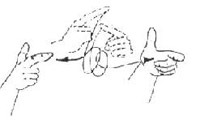 LISTEN Jennifer Crowell (Administrative Lead) Kulvir Singh Sugnesh Patel Susan Philip Abraham Evangelista |
LISTEN is a turnkey voice to Signed English language interpreter that offers end users the ability to convert from spoken English to Signed English in a near real-time environment. It offers easy integration with popular presentation software, and interactive modes for both Signed English training, and on-the-fly speech interpretation. | N/A | David Breen, William Regli Department of Computer Science Drexel University |
| 5 |  FullCourt Tu Vu Administrative Lead Dan Markley Technical Lead Tim Conville Tim Fagan |
Full-Court Physics is an educational game where students learn physics by competing against the computer in an interactive basketball game. In the basketball game, each student must solve physics problems using well-known principles in order to advance the ball towards the net and to score points. The game will be used in high school and college freshmen classrooms to help facilitate the learning of physics. Since Full-Court Physics will be used in a variety of settings, it will be cross-platform to accommodate the different settings. In addition, Full-Court Physics also provides a teacher application that monitors each student’s progress throughout the game allowing the teacher to know who needs help. Also, Full-Court Physics will come with a physics engine called Phlash which can be used in the development of future games. | Prof. Jonathan Awerbuch and Prof. Franco Capaldi Department of Mechanical Engineering and Mechanics Drexel University |
Werner Krandick Department of Computer Science Drexel University |
| 6 |  VODKA Sunny Huynh Team Lead Archit Baweja Drew Hall Kevin Lynch Kanwarpreet Seth |
VODKA is financial management and planning software, similar to Microsoft Money and Quicken, but refined for use by student organizations in a university. Like Quicken and other similar software, VODKA does not directly affect the funds in financial accounts, rather is used to record transactions externally performed on the accounts. Through a web-based interface, VODKA allows users to remotely access and manage their financial accounts. It features a user authentication system that restricts access of users to specific accounts for which they are assigned. VODKA automatically produces an audit trail providing a recorded history of all transactions so that university personnel may review account activity. To assist in financial planning, VODKA generates bar chart and pie chart style reports on spending habits and trends. For added flexibility VODKA allows the financial data to be exported, enabling users to perform their own analysis |
John Cooke, Director of Campus Activities Bridget Scanlan, Assistant Director of SAFAC The Mathematics and Computer Science Society The Drexel Indian Student Association |
Yuanfang Cai Jeff Salvage Department of Computer Science Drexel University |
| 7 |  MSDTool Joshua Shaffer Team Lead David Turner Mark Zuber Sonal Gupta |
MSDTool provides a computer aided engineering (CAE) framework for material scientists and engineers. Utilizing new models and analysis methods from research, in particular the work of the Microstructure Sensitive Design lab in Drexel University's material sciences department, MSDTool allows designers to visualize and explore the possible design parameters (e.g., elasticity) that are physically possible for a given material. Additionally, MSDTool permits researchers to add additional models and techniques into the system as needed. This system advances the state-of-the-art in the material sciences by putting new design methodologies in the hands of those who could benefit from them by means of applying software engineering techniques. | Surya Kalidindi David Fullwood Department of Materials Science and Engineering Drexel University |
Dario Salvucci Department of Computer Science Drexel University |
| 8 |  SITS David Oakes Team Lead Lawrence Katz Technical Lead Jeff Hamel Darshil Amin Joseph Pace |
The Skills Inventory Tracking System (SITS) tracks the progress of nursing students as they learn and develop proficiency in specific nursing skills. Students use a PDA to view their skill sheets and to retrieve faculty signatures when they have demonstrated proficiency in a skill. This information is uploaded to a server of the College of Nursing and Health Professions that can be accessed through the SITS website. Faculty use the website to approve or deny skill requests which are accompanied by the student's photograph and the faculty member's signature. Using these ../images faculty members can quickly verify the validity of the request and prevent digital forgeries. Students use the website to view and print their current skill sheets. Faculty and administrative staff use it to view individual, group or aggregate records in order to identify student learning needs. SITS streamlines skill acquisition and helps instructors fine-tune the clinical program. SITS thus helps to ensure that every student receives a quality education | Fran Cornelius (DU-CNHP) Mary Gallagher-Gordon (DU-CNHP) |
Werner Krandick Department of Computer Science Drexel University |
| 9 |  SITS2007 Sara Vijain Administrative Lead James Mosley Technical Lead Tzvi Heit John Iannelli Corinne Mandell |
The Skills Inventory Tracking System is a nursing skill acquisition management system enabling tracking and revision of skills acquired throughout nursing academics. A PC application having an Internet browser interface and an associated PDA application provide skill retrieval and update capabilities over secure channels interacting with a centralized database according to role-based privilege levels. Individual, group, or aggregate records can be viewed by faculty and administrative staff in order to identify student learning needs. The PDA application is used to record student skills after demonstrated performance. The application captures a digital representation of the evaluating faculty member’s signature and thus allows for subsequent confirmation by the same faculty member. | Fran Cornelius (DU-CNHP) Mary Gallagher-Gordon (DU-CNHP) |
Werner Krandick Department of Computer Science Drexel University |
| 10 |  Clinical Placement Tool Keith Wagner Administrative Lead David Rudy Technical Lead Jermond Love Brett Goldenbloome |
Every term, the nursing students at Drexel University College of Nursing and Health Professions (CNHP) work in hospitals to gain experience in a real-world environment. The Clinical Placement Tool is a dynamic web application that streamlines the process of matching the students in the program with their clinical sites. The placement is subject to a number of site- and student-related constraints and is performed using a set of rules that can be set by the user. Currently, the process is carried out by hand. However, the manual placement of 500 or more students each term is overwhelming, and the results are not optimal. | Fran Cornelius (DU-CNHP) Mary Gallagher-Gordon (DU-CNHP) |
Kurt Schmidt Department of Computer Science Drexel University |
| 11 |  Clinical Placement Tool Lucas Stankiewicz Team Lead Ekaterina Beregovaia Dave Cupp Natasha Karpenko Gwen Roberts |
The Clinical Placement Tool (CPT) is a web based, database driven application that automates the assignment of students to clinical sites in the College of Nursing and Health Professions. The process is currently done manually on paper and takes one week to be completed by a handful of employees. The CPT front-end application utilizes PHP web technology in combination with a MySQL database to manipulate and view data. The actual assignment process is completed by a C++ application that runs independently of the front-end. | Fran Cornelius (DU-CNHP) Mary Gallagher-Gordon (DU-CNHP) |
Dario Salvucci Department of Computer Science Drexel University |
| 12 |  DrexelQuetzal Kristin McLane Team Lead Jesse Brown Technical Lead Kenny Lundberg Matt Whitehead Mary Stewart |
Quetzal is a scheduling application designed to provide students and faculty with a utility that streamlines the act of choosing and organizing the quarterly schedule for undergraduates at the university level using a GUI drag-and-drop interface. Quetzal has the following major components. - A Calendar View, which allows term-by-term planning for course scheduling based on course prerequisites and term of offering. The Calendar View also allows for queries of the university's database for course information such as days and times, and it allows term schedule scenarios to be saved - A History View, which shows a list of classes previously taken by the student - A Degree Completion View, which allows comparison of the student’s class history with curricular requirements. This software initially applies only to Computer Science undergraduates and faculty at Drexel University. It can be expanded to be used by any major or school in the future. |
N/A | Jeff Popyack Department of Computer Science Drexel University |
| 13 |  enGen Alfred Beyer Team Lead Michael Angstadt Brendan Callahan Abel Getachew Erik Krajnikovich |
enGen ( Design of an Intelligent Datamart for Efficient Operation a Commercial Building ) is a software system for managing the building efficiency of medium to large office buildings. Modern office buildings supply their managing engineers and/or efficiency contractors with an abundance of building statistics. Managing this data is complicated and time consuming. enGen allows users to view these statistics through graphical and text formats that they are accustomed to. By providing unbiased data processing for these statistics, a building manager may optimize the usage of utilities by maximizing hardware life span and minimizing operational cost. This, in turn, maximizes user profit. | Agami Reddy Department of Civil, Aeronautical and Environmental Engineering Drexel University |
Jeff Salvage Department of Computer Science Drexel University |
| 14 |  DrexelRadar Ryan Schultz Administrative Lead Joel Piazza Technical Lead Brian Gordaychik Jon Beaumont |
Drexel RADAR is and agent-based calendar management tool employing constraint satisfaction techniques. Built using Google's mail and calendar services. Drexel RADAR allows the user to have access to their most important information wherever they have internet access. After a brief setup process on a home machine, the user's RADAR agent will immediately start learning about its owners scheduling preferences. with the ultimate goal being complete automation with no user involvement. These agents handle meeting requests amongst any number of participants, including both RADAR users and regular human participants. The DrexelRADAR system combines leading edge Artificial Intelligence algorithms with a transparency and ease of use that is sure to bolster productivity and lessen the stress of meetings. |
N/A | Jay Modi William C. Regli Department of Computer Science Drexel University |
| 15 |  RCCM |
The project improves the Remote-Controlled Crack Monitoring (RCCM) Video System used for non-destructive monitoring of fatigue cracking in the unique fuselage panel testing facility at FAA Technical Center near Atlantic City International Airport. The new system features additional motors, an improved frame, and a new computer system. The new computer system adds functionality to make crack measuring quicker and easier while maintaining accuracy. The system consists of a single computer with dual monitor output, one for the software control center, and one for the video feeds. The software controls the movement of two video cameras, it captures the video output, supports crack measurement, and manages archiving and retrieval. | Jonathan Awerbuch Alan Lau Tein-Min Tan John Bakuckas Department of Mechanical Engineering and Mechanics Drexel University |
Werner Krandick Department of Computer Science Drexel University |
| 16 |  SeeingEyeShopper Raffi Hovagimian Team Lead Husam Abushariefeh Technical Lead Charles Le Shashank Sharma |
Seeing Eye Shopper (SES) enhances the B.A.S.S. project of 2006 by creating a full shopping experience for blind persons. The project completes the intentions of B.A.S.S. by creating a site that allows blind persons to create shopping lists, and by allowing stores to become accessible to the system. The list creation system allows users to create, edit and retrieve lists that will be loaded on the shopping cart before the user starts to shop. The store management system allows managers to add, edit and remove product entries. The system also allows managers to add information about the Radio Frequency Identification (RFID) tags associated with each product in the store. SES interacts with barcode readers, sensors, and - incorporating Bluetooth audio - with human speech. The program code is written in C#. | Overbrook School for the Blind | Jeff Salvage Department of Computer Science Drexel University |
| 17 |  Frugalphone Stephen Prazenica Team Lead Patrick Freestone Jonathan Saunders Kyle Usbeck Kimmie Yuan |
The objective of FrugalPhone is to provide a mobile price comparison service for consumers. Products are identified by the consumer on his/her mobile device by name or UPC code. Information returned to the consumer includes store name, physical location, sale price, and the last time the price was validated for the specified product. GPS-enabled phones also display the distance to the nearest store. The goal of FrugalPhone is to provide the ability to compare product prices anytime and anywhere | N/A | Jeff Salvage Department of Computer Science Gregory W. Hislop College of Information Science and Technology Drexel University |
| 18 |  Evac-Op Christopher J. Carpenter Christopher J. Dugan Joseph B. Kopena Robert N. Lass Duc N. Nguyen |
Evac-Op is a prototype system for assisting emergency personnel in monitoring and conducting evacuation and sheltering operations. It is a novel application of distributed constraint optimization combined with mobile wireless networking to sharing situation information and making global decisions on issues such as shelter assignments. In addition to exploring this new application of distributed constraint optimization, Evac-Op is intended as a research platform for investigating distributed decision making under poor communications, uncertainty, and change | N/A | Pragnesh Jay Modi,
William C. Regli Department of Computer Science Drexel University |